Most safety conversations in a warehouse start with the obvious stuff – proper signage, forklift training, marked walkways. What gets skipped over way too often is the actual surface everyone’s standing and driving on all day. If the floor underneath is cracked, uneven, or slick from years of spills soaking into bare concrete, all those other safety measures are working uphill against a problem that never gets fixed. That’s really the case for epoxy flooring for warehousing: it’s not just a maintenance upgrade, it’s one of the more overlooked pieces of a genuinely safer facility. Let’s talk through why the floor deserves more attention than it usually gets.
Why Warehouse Epoxy Flooring Plays a Bigger Role in Safety Than You’d Think
It’s easy to assume safety comes down to training and procedures, but the physical environment matters just as much. A cracked or pitted floor creates tripping hazards that no amount of signage fixes. Porous concrete soaks up spilled oil or water, leaving slick patches that are hard to spot until someone’s already lost their footing. None of this is dramatic on its own – it’s the kind of thing that builds up quietly until an incident happens and everyone’s suddenly asking how it was missed.
A properly installed coating addresses a lot of that at the source. The sealed, seamless surface means spills sit on top instead of soaking in, which makes them easier to see and clean up quickly. Slip-resistant additives can also be worked directly into the coating, adding traction in exactly the spots where accidents are most likely to happen.
Reducing the Everyday Risks Nobody Talks About
Beyond the obvious slip-and-fall concerns, there’s a quieter set of risks tied to dust and airborne particles kicked up by deteriorating concrete. That dust doesn’t just look bad; it can aggravate respiratory issues for workers spending long shifts on the floor, and it settles on equipment in ways that shorten its usable life. A sealed surface cuts that dust down substantially, which is a safety benefit that rarely gets mentioned but genuinely matters over time.
What a Well-Designed Coating Actually Adds to a Facility
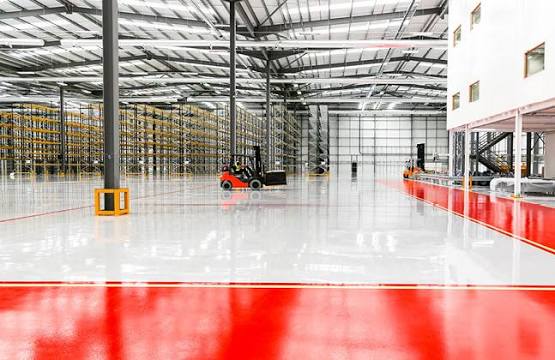
Color and layout choices aren’t just cosmetic decisions either. Bright, contrasting striping can mark pedestrian walkways, forklift lanes, and hazard zones directly into the floor itself, which tends to hold up a lot better than painted tape or temporary markers that peel and fade within months. This is part of why so many facilities researching epoxy flooring for warehousing end up including zone marking in the same project instead of treating it as a separate cost later. Lighter coating tones also reflect more ambient light, improving visibility across the space without needing to install additional fixtures overhead.
None of this replaces proper training or clear procedures, but it does remove a category of hazards that training alone can’t fix. A worker following every safety rule perfectly can still slip on a patch of concrete that’s been quietly degrading for years.
How Warehouse Epoxy Flooring Supports OSHA-Friendly Work Conditions
Facilities working to stay ahead of compliance standards often find that flooring plays a bigger part than expected. Warehouse epoxy flooring, when installed with proper slip resistance and clear zone markings, directly supports the kind of walkable, hazard-free environment that inspectors and safety officers actually look for. It’s one of those upgrades that quietly checks several boxes at once instead of needing separate fixes for each individual concern.
Choosing a Contractor Who Understands Both Safety and Durability
Not every flooring company thinks about safety as part of the job – plenty are focused purely on appearance or speed of installation. It’s worth asking specifically how they approach slip resistance, traffic zone marking, and surface prep, since those choices affect how the floor performs once it’s back in daily use.
One good step before hiring anyone:
- Ask whether they can customize slip-resistant texture and zone striping as part of the same installation, rather than treating those as separate add-on services later.
Getting proper answers to that question tends to separate contractors who genuinely understand industrial safety from ones who are just applying a generic coating. A specialist in epoxy flooring for warehousing will usually walk you through these options without being asked twice, because they already know how much they matter once the floor is back under heavy, daily use.
Conclusion
A warehouse floor that’s cracked, dusty, or slick is quietly working against every other safety measure a facility puts in place, even when nobody’s connecting the dots. Investing in a properly installed coating closes that gap, giving workers a surface that’s easier to keep clean, easier to see clearly, and far less likely to cause an avoidable accident. When you’re ready to take that step, High Performance Systems brings the kind of practical, safety-minded experience that makes the difference between a floor that just looks good and one that genuinely protects the people working on it. It’s an upgrade that keeps paying off in ways that go well beyond appearance.
Frequently Asked Questions
- Does this type of flooringactually reduceslip-and-fall incidents?
Yes, especially when slip-resistant additives are built into the coating, which significantly improves traction in spill-prone areas.
- Can safety markings like walkways be added directly into the floor?
Absolutely. Contrasting striping and zone markings can be applied as part of the coating, and they hold up far longer than painted tape.
- Does it help with dust-related health concerns in the facility?
Yes, a sealed surface significantly cuts down on airborne dust from deteriorating concrete, which improves overall air quality on the floor.
- Is this kind of upgrade something inspectors typically notice?
Often, yes. A clean, well-marked, slip-resistant floor tends to reflect positively during general safety and compliance walkthroughs.
- How soon can safety benefits be expected after installation?
Immediately in most cases, since the improved traction, visibility, and cleanliness take effect as soon as the coating is fully cured.